Linked product
A Linked product option turns one of your existing Shopify products into a picker on another product’s page. Instead of typing values by hand, you point the option at a real product — say a Frame product with Size and Color variants — and OptionWise pulls in its values, prices, and live stock automatically. When the customer makes a choice, that real frame is added to the cart, so Shopify keeps its price and stock accurate for you — there’s no separate stock count that can drift out of date or oversell.
A single option shows one picker per variant option the linked product has (Size, Color, …), and the customer’s choices add up to one specific frame.
This is a power feature, so it lives at the bottom of the type picker under Advanced. Most stores never need it — reach for it only when an option needs to draw on a real product’s stock.
When to use it
The motivating case is shared inventory across many products. Imagine a shop with 100 art prints, each offered in the same range of physical frames. The frames are the only finite stock. Rather than recreating frame variants on all 100 prints (and keeping one frame pool in sync across them), you:
- Keep one “Frame” product that holds the real frame stock.
- Add a single Linked product option bound to that Frame product.
- Target the option set at every print.
Now a customer on any print picks a frame, that real frame is added to their cart, and it comes out of the one shared frame stock. One source product backs all 100 prints.
The Linked product option is what makes the option inventory-backed. Making it appear on many products is ordinary option-set targeting — the two work together. The Linked product type does not fan an option out across products by itself.
How it’s different from a normal option
| Normal option (e.g. Dropdown) | Linked product | |
|---|---|---|
| Values | You type them | Pulled from the linked product’s variants |
| Price | You set add-on prices | The linked variant’s own price |
| Stock | Not tracked | The linked variant’s live Shopify inventory |
| In the cart | One line, options listed on it | One line, with the chosen variant grouped under the product |
Think of it as controlled, not frozen: the linked product owns the values, their order, the price, availability, and the option’s name. You still own how each dimension is presented, plus visibility, default, whether it’s required, and where it sits in the option set.
Add a Linked product option
- In your option set, click Add another option.
- Set Type to Linked product (under the Advanced group at the bottom of the list).
- Click Select a product and choose the product whose variants you want to offer (for the framing example, your Frame product).
- OptionWise reads the product and shows its variant options (Size, Color). For each one, pick how it should appear — Buttons, Dropdown, or Radio buttons.
- Save.
The option’s name comes from the linked product and can’t be edited here: the plugin renders one title per option, and that title is the product.
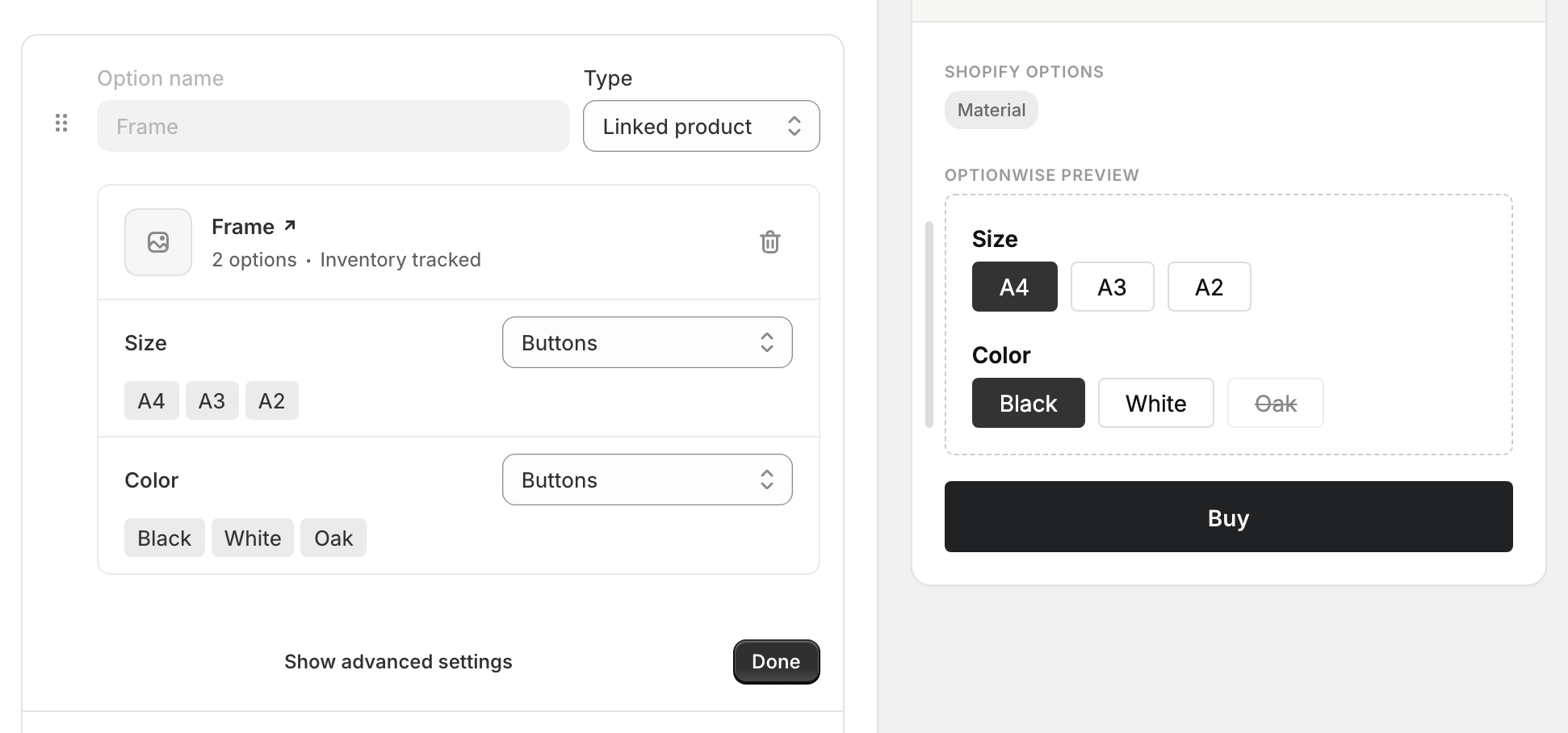
What customers see
A single labeled control with one picker per variant option (Size, then Color). As the customer narrows their choice, combinations that are out of stock or don’t exist are disabled — the same behavior as Shopify’s own variant picker. Their choices add up to one specific frame, which is added to the cart.
Pricing
You don’t set add-on prices for a Linked product option — the price comes from the linked product. The customer pays the original product’s normal price plus the chosen frame at the frame’s own price. Because the frame is a real Shopify product, sale prices, B2B catalogs, and multiple currencies all work automatically.
Because there’s nothing to set, the editor doesn’t show a Pricing panel for this type. See How pricing appears in cart for how this looks to the customer.
In the cart and at checkout
The product and the chosen frame travel together as one cart line: the product on top, with the frame listed underneath it as part of the same line. That grouping is Shopify’s own way of showing a product bought with a component — it isn’t something your theme adds, and it’s what keeps the two moving together:
- Change the product’s quantity and the frame’s quantity changes with it.
- Remove the product and the frame goes too.
Checkout keeps the same grouping. On the order in your admin, the product and the frame are separate line items grouped together, each at its own price. Both also show in the order confirmation email; see Notification emails for the one-time template step that lists the customer’s selections there.
Shipping
Shipping treats the frame as a real item in the order, not as an add-on to the product. Weight-based and carrier-calculated rates count the frame’s weight on top of the product’s own, and shipping apps see both items. So give every frame variant an accurate weight in Shopify, just as you would for a product sold on its own — a frame with no weight set ships as if it weighed nothing.
Inventory
This is the headline benefit. Because the customer is choosing a real product variant, Shopify counts its stock exactly as it does for any product:
- When a frame is out of stock, customers can’t add it.
- Every product that offers the frame draws on the same real stock, so it can’t be oversold — when the last one’s gone, it’s unavailable everywhere it appears.
- Stock is checked again at checkout, just as Shopify always does.
There’s no separate stock count to keep in sync — it’s always Shopify’s own, so it can never drift out of date.
Advanced settings
- Validation → Required — require the customer to choose a variant before adding to cart.
- Default — preselect a starting variant combination. Defaults to the first available variant.
- Visibility — show the picker only after another choice is made. See Conditional logic. (A Linked product option can be shown or hidden by a rule, but can’t be used as the trigger for one.)
- Pricing — nothing to set; see Pricing above.
Keep the linked product on the Online Store
For a linked product to appear on your live product pages, it has to be published to the Online Store sales channel. OptionWise renders the option on the storefront by reading the linked product through your theme, and Shopify only exposes products that are on the Online Store there.
If you remove the Online Store channel from the linked product — but leave the product itself active — something confusing happens:
- In the editor preview, the option still appears. The editor reads the product directly from Shopify’s admin, which sees it regardless of channel.
- On the live product page, the option silently disappears. The storefront can’t see a product that isn’t on the Online Store.
So the preview doesn’t mislead you, OptionWise shows a warning on the linked product in the editor when this happens — the option you’re previewing won’t appear on your live pages until the channel is restored.
Fix: open the linked product in Shopify and, under Publishing (or Sales channels), add it back to the Online Store. The option reappears on your product pages.
This is different from deleting or fully unpublishing the product (below), which OptionWise flags as source removed. Here the product still exists and still works in the cart — it just can’t be shown on the storefront until it’s back on the Online Store.
Hiding a linked product from shoppers
Sometimes the linked product is a pure “stock holder” — a Frame product that backs the picker but that you never want shoppers to find or buy on its own. You can hide it from your storefront without taking it off the Online Store (which would stop the options rendering). This is the same approach bundle apps use for the hidden products behind a bundle:
- Set the product’s status to Unlisted. An unlisted product stays on the Online Store channel — so OptionWise can still read it and render the options — but it no longer shows up in your storefront search, collections, or product recommendations, is left out of your sitemap, and is hidden from Google and other search engines. It’s only reachable by a direct link.
- Stop it being bought on its own. An unlisted product can still be added to the cart from a direct link, so if it must never be purchased alone, create a product template with the Buy buttons block removed and assign it to the product (you can add a note like “Not for individual sale”).
Hide it with Unlisted, not by removing it from the Online Store sales channel. Removing the channel stops OptionWise from reading the product, so the options vanish from your live pages (and you’ll see a warning in the editor). Unlisted keeps the option working while hiding the product.
If the linked product goes away
If you delete or unpublish the linked product, OptionWise doesn’t break your storefront. The editor flags the option as source removed so you can re-link a different product or delete the option, and the product page renders the option in a safe unavailable state rather than erroring.
Related
- Assign options to products — target one Linked product option across many products
- How pricing appears in cart — how the charge appears to the customer
- Dropdown — a plain single-select when you don’t need inventory backing